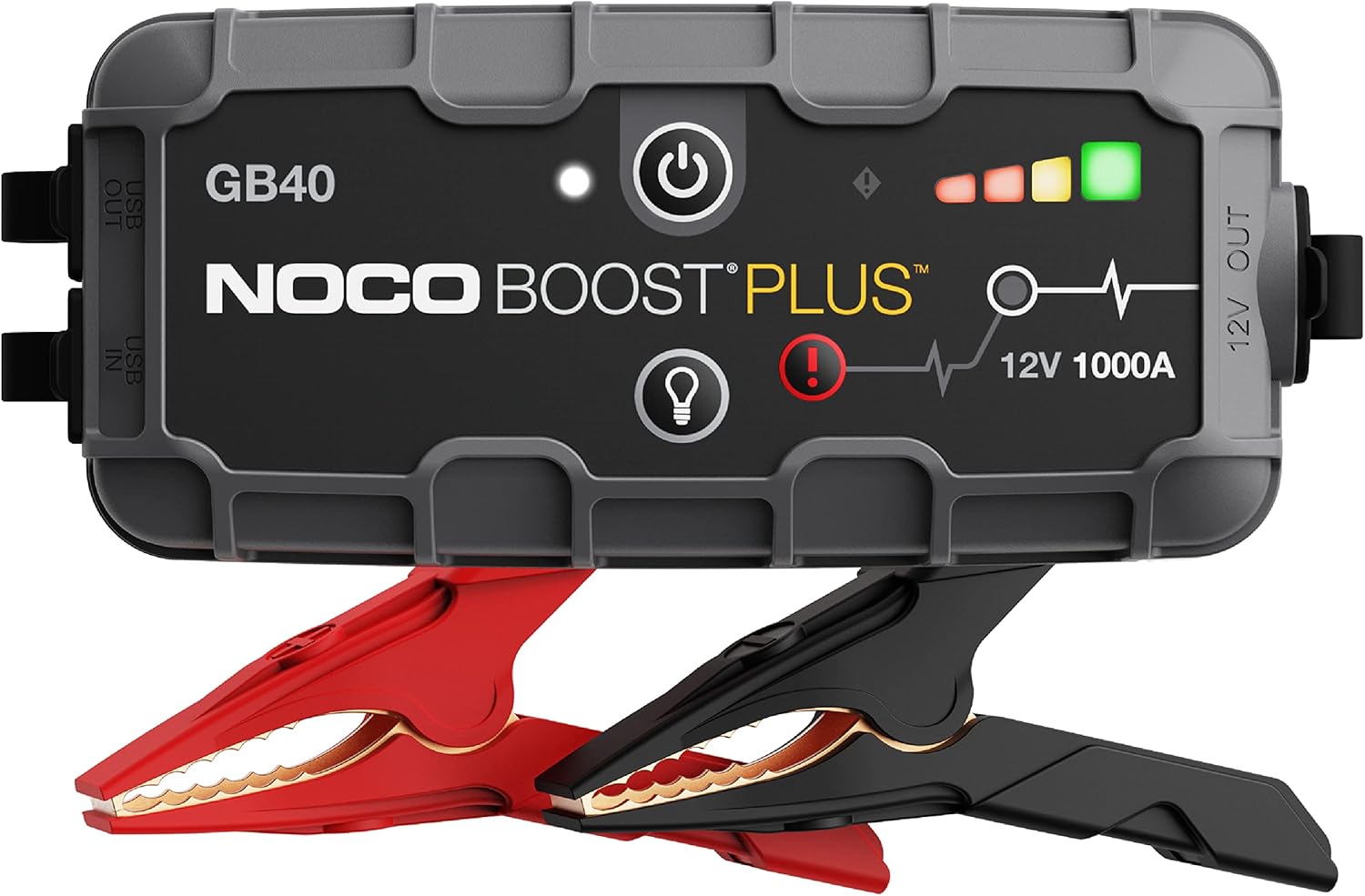
The best portable jump starter for most drivers is the NOCO Boost Plus GB40 —
1,000 amps in a 2.4-lb box that started a 4.6L V8 with its battery fully disconnected
in Garagest Picks' 19-unit test. If you want one box that also airs up a tire, the
GOOLOO A3 Lite
adds a 150 PSI auto-stop inflator for about $15 more. And if the battery dies every
few weeks, what you actually need is the
NOCO GENIUS10 charger, not another jump.
Our picks at a glance
Ranked. The full case for — and against — each one is below.
The benchmark everyone else is measured against. In Garagest Picks' 19-unit test it started a 4.6L V8 with the battery completely disconnected and took the overall win for build and clamps; TechGearLab cranked a 4.0L V6 Explorer three times in a row in cold weather. The spark-proof, reverse-polarity-protected clamps make it close to impossible to hook up wrong, and owners report it holding charge for months in a glovebox.
One paperback-sized box for both roadside failures: a jump starter with a BOOST mode for batteries too flat to be detected, plus a 150 PSI digital inflator with five presets that shuts off at the target. The regular A3 it's cut down from carries a 4.6-star record across 663 Walmart ratings and landed within 0.1 PSI of target in 737mechanic's torture test.
Not a jump starter — the thing you plug in so you stop needing one. Its force mode recovers batteries other chargers refuse to recognize, it remembers its mode after a power outage, and Garage Journal owners report running several units for years across trucks, boats and mowers after older Battery Tender maintainers died on them.
The $26 insurance policy for anything that sits for weeks: clip it on, and the battery never goes flat in the first place. At 1 amp it is a maintainer, not a reviver — CarXplorer works out more than 40 hours to fill a dead 60Ah car battery — but for a motorcycle, mower or winter-stored car that is exactly the job.
This guide covers the whole dead-battery kit, because "jump starter" is the wrong search
for about half the people typing it. A jump starter is a lithium pack that
dumps a few hundred amps for a few seconds to crank an engine on the roadside. A
battery charger and maintainer plugs into a wall and spends hours actually
refilling and conditioning the battery — the fix for the car that needs a jump every
other Monday. We compare two jump starters (the NOCO GB40 benchmark and GOOLOO's new
jump-and-inflate combo) and two NOCO Genius chargers, using independent tests from
Garagest Picks, TechGearLab and Project Farm rather than the peak-amp numbers on the box,
which Project Farm's bench testing calls "marketing fiction across the board." If a flat
tire is the other half of your roadside worry, our
portable tire inflator guide
and
cordless inflator picks
cover that side of the trunk.
How we picked
Real engines, not peak amps. We weighted tests that cranked actual
vehicles with the battery disconnected or drained — Garagest Picks across 19 units and
2.0L-7.3L engines, TechGearLab's cold-weather repeat starts, Project Farm's carbon-pile
bench — over the 1,000A/2,500A headline, which independent meters consistently measure at
30-80% of the claim. Safety circuitry. Spark-proof, reverse-polarity-protected
clamps and a usable override for deeply discharged batteries. Charge retention.
How long the pack stays ready in a glovebox, and how it's recharged. Honest engine
ratings. We flag where a seller's rating and the manufacturer's disagree. For the
chargers: amperage, chemistry support, force/desulfation modes and multi-year owner
reliability on garage and boating forums.
The kit, side by side
Model
Type
Output
Rated for
Best for
NOCO Boost Plus GB40
Jump starter
1,000A peak · 2.4 lb
6.0L gas / 3.0L diesel
One in every car
GOOLOO A3 Lite
Jump starter + inflator
2,500A peak · 150 PSI · 1.7 lb
4.0L gas (GOOLOO) / 7.0L (Amazon)
Compact cars, one-box kit
NOCO GB70 (not reviewed here)
Jump starter
2,000A peak · 5.0 lb
8.0L gas / 6.0L diesel
Big V8s, diesel pickups
NOCO GENIUS10
Charger + maintainer
10A · wall powered
6V/12V lead-acid, 12V lithium
Battery that keeps dying
NOCO Genius1
Maintainer
1A · wall powered
6V/12V lead-acid, 12V lithium
Bikes, mowers, stored cars
Peak amps and engine ratings are manufacturer figures; prices fluctuate on Amazon — each review page links to the live listing.
1,000A peak · rated 6.0L gas / 3.0L diesel · 2.4 lb · IP65 · ~3 h recharge
Why it's here: The benchmark everyone else is measured against. In Garagest Picks' 19-unit test it started a 4.6L V8 with the battery completely disconnected and took the overall win for build and clamps; TechGearLab cranked a 4.0L V6 Explorer three times in a row in cold weather. The spark-proof, reverse-polarity-protected clamps make it close to impossible to hook up wrong, and owners report it holding charge for months in a glovebox.
Against it: Real-world jump counts run 8-15 per charge, not the rated 20; a deeply discharged battery trips the safety circuit until you hold the manual-override button; the 3.0L diesel ceiling rules out most diesel pickups.
Why it's here: One paperback-sized box for both roadside failures: a jump starter with a BOOST mode for batteries too flat to be detected, plus a 150 PSI digital inflator with five presets that shuts off at the target. The regular A3 it's cut down from carries a 4.6-star record across 663 Walmart ratings and landed within 0.1 PSI of target in 737mechanic's torture test.
Against it: Brand new, with no owner reviews yet, and GOOLOO itself can't agree on the engine rating — 7.0L gas on Amazon, 4.0L gas on gooloo.com. Trust the smaller number. The regular A3 (3,000A, 44.4 Wh) is often cheaper on sale.
Why it's here: Not a jump starter — the thing you plug in so you stop needing one. Its force mode recovers batteries other chargers refuse to recognize, it remembers its mode after a power outage, and Garage Journal owners report running several units for years across trucks, boats and mowers after older Battery Tender maintainers died on them.
Against it: Needs a wall outlet, so it does nothing on the roadside; the cables stiffen badly in deep cold, and a minority of owners report early failures with a slow warranty process.
Why it's here: The $26 insurance policy for anything that sits for weeks: clip it on, and the battery never goes flat in the first place. At 1 amp it is a maintainer, not a reviver — CarXplorer works out more than 40 hours to fill a dead 60Ah car battery — but for a motorcycle, mower or winter-stored car that is exactly the job.
Against it: Far too slow to rescue a dead car battery in a hurry, and a BobIsTheOilGuy thread documents a vocal minority of units failing inside the first year — register the warranty.
Peak amps vs cranking amps: the spec that fools everyone
The big number on the box is peak amps: the instantaneous current the pack
can push into a dead short for a fraction of a second. What starts an engine is
cranking current sustained for a few seconds, and the two barely correlate.
Project Farm's carbon-pile bench made the point bluntly: a unit advertising 8,000A delivered
4,226 watts of cranking power while a NOCO advertising 4,250A delivered 7,156 watts — and
the conclusion across 13 units was that advertised cranking amps "mean almost nothing."
Garagest Picks, with a clamp meter on 19 units, measured real output at 30-80% of claims
and advises buyers to ignore peak amps and look for a cranking-amp (CA) or cold-cranking
(CCA) figure, or better, the manufacturer's engine-size rating. That is why the 1,000A GB40
sits above GOOLOO's 2,500A Lite in our ranking: NOCO's engine rating is conservative and
independently confirmed, while the Lite's 200A sustained output is the number that matches
its 29.6 Wh pack. Battery capacity tells the same story — TechGearLab measured the GB40 at
15.57 Wh against a 24 Wh rating — so treat every spec-sheet amp figure as a ceiling, and
every "up to 20 jumps" claim as a best case.
What size jump starter for a V8 or a diesel?
The GB40's own buyers draw the line clearly: it worked worst on big-block V8s and larger
diesels, which need a bigger pack. NOCO's step up is the Boost HD GB70
— 2,000A, rated 8.0L gas / 6.0L diesel, 5.0 lb, up to 40 starts per charge, about $200 —
and it is the unit NOCO itself points GB40 owners toward for diesels and 5.7L-plus V8s.
The Hulkman Alpha85 (2,000A, 74 Wh, rated 8.5L gas / 6.0L diesel) is the
popular alternative at that tier: TechGearLab gave the Alpha85S an Editors' Choice, and
its 3.3-inch screen, 0-to-80%-in-an-hour recharge and 5-minute emergency charge are
conveniences the GB70 lacks. For the 6.6L Duramax and 7.3L Power Stroke crowd there is the
GOOLOO GP4000 (4,000A, rated for all gas engines and diesels to 10.0L,
~$150), which a Cheap RV Living contributor uses to start a 6.6L Duramax ambulance. None of
the three is in our catalog yet, so we rank the GB40 as the pick for the cars most people
drive, and send V8 and diesel owners to that 2,000A-plus class. Whatever you buy, keep a
pressure gauge
in the same pouch — a slow-leaking tire is the roadside failure that actually happens more often.
Jump starter vs battery charger: which one solves your problem
If the battery died once because of dome lights or a week at the airport, a jump starter
is the whole fix. If it dies repeatedly, a jump starter is a bandage: every deep discharge
sulfates the plates a little more, and a pack that only cranks the engine never refills
the battery — your alternator does, slowly, and only if you drive long enough. That is the
job of the GENIUS10:
10 amps overnight, a diagnostic and desulfation cycle, a force mode for batteries too dead
to be detected, then a maintenance float you can leave connected all winter. The
Genius1
is the same idea at 1 amp and $26 — too slow to revive a car battery (over 40 hours from
flat on a 60Ah battery) but ideal clipped onto a motorcycle, mower or a car that sits for a
month. The practical kit for most households is a GB40 in the glovebox and a GENIUS10 on the
garage wall; the A3 Lite replaces the GB40 if you'd rather carry one box for jumps and tires;
and the Genius1 is the cheap add-on for whatever seasonal battery you keep forgetting about.
Frequently asked questions
What size jump starter do I need for my car, a V8 or a diesel?
Go by the manufacturer's engine rating, not the peak-amp headline. A 1,000A-class unit like the NOCO GB40 (rated 6.0L gas / 3.0L diesel) covers four- and six-cylinder cars, crossovers and small V8s — independent testers have started a 4.6L V8 with it. For a 5.7L-plus V8 that sits in the cold, or any diesel pickup, step up to a 2,000A-class unit with a bigger battery: the NOCO GB70 is rated 8.0L gas / 6.0L diesel and the Hulkman Alpha85 8.5L gas / 6.0L diesel. For 6.6L-7.3L diesels, buyers lean on 4,000A-class units like the GOOLOO GP4000 (rated for diesels to 10.0L; one owner starts a 6.6L Duramax ambulance with it).
How long does a jump starter hold its charge?
Lithium units self-discharge slowly: NOCO GB40 owners report months between top-ups, GOOLOO claims up to 24 months of standby for the A3 Lite and 90% capacity after 24 months for the A3, and a GP4000 owner reported 90% after five years of light use. The practical rule from every tester is the same — check it every three to six months (TechGearLab says at least every six) and recharge with the oil changes, because the jump starter that disappoints is the one that sat in a hot trunk all summer.
Can a jump starter damage my car?
A modern lithium unit with reverse-polarity and spark-proof protection — every pick here has it — is safer than cables from a running car, which can spike the donor's alternator and your electronics. The risks are user errors: clamping to the wrong terminals on a unit without protection, cranking repeatedly past the recommended pause (most units specify a 30-second to one-minute cool-down between attempts), or using a manual-override/BOOST mode on a battery that is physically shorted. Clamp red to positive, black to a bare chassis ground or the negative terminal, start, then remove the pack within a minute or two.
Jump starter vs battery charger — which one do I need?
A jump starter is the roadside tool: a lithium pack that dumps hundreds of amps for a few seconds to crank the engine, then gets put away. A battery charger and maintainer like the NOCO GENIUS10 or Genius1 plugs into a wall and pushes 1-10 amps for hours to actually refill and condition the battery. If your battery died once because you left the lights on, a jump starter is enough. If it dies every few weeks, a jump starter just postpones a new battery — a charger diagnoses and desulfates it, and a maintainer stops the slow drain on a car that sits. Most households end up wanting one of each.
Can you leave a jump starter in a hot car?
Briefly yes, all summer no. Lithium cells degrade when stored above about 122-140°F (50-60°C), and a parked car in sun can reach 158-176°F inside; GOOLOO sets the A3 Lite's storage ceiling at 140°F and Men's Journal flagged it as a real concern for a car parked in Florida sun. The glovebox or under a seat runs cooler than the dash or a trunk against the rear glass, and most testers recommend bringing the pack indoors through heat waves and deep-freeze cold snaps. Capacity drops in cold too: Project Farm's 0°F freezer tests cut cranking output on every unit tested.
How many jumps do you get per charge?
Less than the box says. NOCO rates the GB40 for up to 20 starts and the GB70 for up to 40; Garagest Picks counted about 8 realistic starts from a GB40 on real engines, owners typically report 10-15, and TechGearLab measured its usable capacity at 15.57 Wh against a 24 Wh rating. Engine size, battery condition and temperature all cut the count, which is why the testers' advice is to recharge after every use rather than count on the rating.
 1 · Best portable jump starter overall

