The best tire pressure gauge for most people is the ETENWOLF T600 —
a ~$20 hose-and-bleeder digital gauge rated ±0.5% of full scale (ANSI B40.7 Grade 2A) that lets you set a tire, not just read it.
If you only need a glovebox check, the ETENWOLF T300
was the most accurate low-pressure gauge in Project Farm's 23-gauge test — 0 PSI combined error at 16 PSI — for about $8.
The best digital tire pressure gauge under $7 is the AstroAI.
Our picks at a glance
Ranked. The full case for — and against — each one is below.
The format that lets you set pressure instead of just reading it: a rubber hose with a rotating angled chuck, a thumb bleeder and a reading that stays locked until you zero it. The manufacturer rates it ±0.5% of full scale — about ±1.25 PSI anywhere in a 0-250 PSI range — and the one detailed owner review on record says display lag while bleeding was cut 'at least in half' versus his older digital gauge, close to the real-time feel of an analog race gauge.
Project Farm's 23-gauge test put the ~$10 ETENWOLF digital stick at 0 PSI combined error at 16 PSI and 0.1 PSI at 40 PSI — the most accurate gauge in the group at low pressure — and only 3.4 PSI of cumulative error across ten readings, including a 125°F heat soak and 12 hours at -4°F. Forum testers at Bob Is The Oil Guy also found it beating its ±1 PSI grade against reference gauges.
Tied with the ETENWOLF at 3.4 PSI cumulative error in Project Farm's testing, which puts a $7 gauge ahead of the $23 JACO ElitePro dial (7.6 PSI) and the $29 Milton dial (12.1 PSI). Owners report its 0.1 PSI readings track their dashboard TPMS, and the lit nozzle makes driveway checks at night painless.
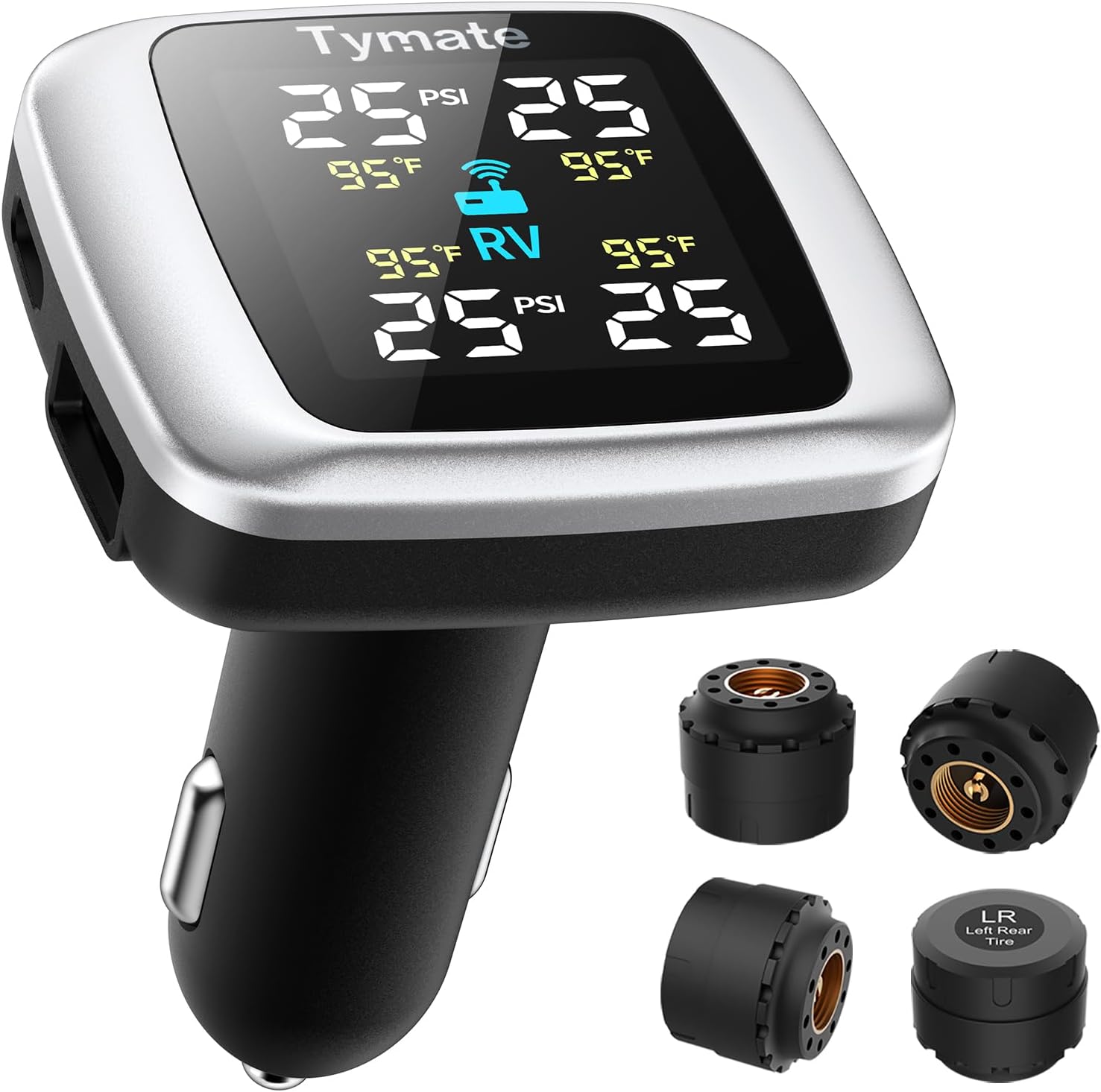
Not a gauge, but it answers the question a gauge can't: what is the pressure right now, while I'm driving? Four screw-on cap sensors install in about five minutes and owners credit the alerts with catching slow leaks before a blowout — on a car whose factory TPMS only lights up at 25% under placard, that is a week or two of warning.
A tire gauge is the cheapest tool in the car and the one most people trust blindly, which
is a problem: in the largest independent test we could find, the spread between the best and
worst of 23 gauges was 0.9 PSI versus 54 PSI of cumulative error. The good news is that
accuracy no longer costs money. Digital stick gauges around $7-10 beat $23-37
dial and race gauges in that test, and the extra dollars now buy format — a hose, a rotating
chuck and a bleeder valve — rather than precision. We ranked four options on third-party
accuracy data, owner reports and the manufacturer's stated ANSI grade, and added an aftermarket
TPMS for the people whose real question is "why didn't my dash warn me sooner?". If your
inflator's built-in gauge is what you've been relying on, our
portable tire inflator guide
explains why those auto-stop readings are a target, not a measurement — and a standalone
gauge is how you verify them.
How we picked
Measured error, not resolution. We lean on Project Farm's reference-gauge
test (two samples per brand, readings at 16, 40 and 60 PSI, plus a 125°F heat soak and 12
hours at -4°F) and Consumer Reports' 17-gauge evaluation; a 0.1 PSI display means nothing if
the sensor is a pound off. Stated standard. We favor gauges whose makers put
an ANSI B40.7 grade on the box over "high precision" marketing. Format for the job.
A stick gauge for the glovebox, a hose-and-bleeder for the garage, and sensors if you want
numbers while driving. Owner-reported quirks — battery drain, seal problems,
display lag — weighed as heavily as the headline spec.
The four, side by side
Model
Type
Range
Accuracy
Best for
ETENWOLF T600
Digital, hose + chuck + bleeder
0-250 PSI
Rated ±0.5% FS (~±1.25 PSI), B40.7 2A
Garage, trucks/RVs, motorcycles
ETENWOLF T300
Digital stick
3-200 PSI
Rated ±1 PSI · 3.4 PSI total error (Project Farm)
Glovebox, best value
AstroAI Digital
Digital stick
0-150 PSI
Rated ~±1 PSI · 3.4 PSI total error (Project Farm)
Cheapest trustworthy gauge
Tymate TM7
Aftermarket TPMS, 4 cap sensors
Live PSI + temp
Owners report a few PSI off at times
Continuous monitoring, older cars
"Total error" is Project Farm's cumulative miss across ten readings per brand versus certified reference gauges; "rated" figures are the manufacturer's. Prices fluctuate on Amazon — each review page links to the live listing.
1. Best tire pressure gauge overall (hose + bleeder)
Digital · 0-250 PSI · ±0.5% full scale (ANSI B40.7 2A) · 0.1 PSI · hose, 360° chuck, bleeder · 2x AA incl.
Why it's here: The format that lets you set pressure instead of just reading it: a rubber hose with a rotating angled chuck, a thumb bleeder and a reading that stays locked until you zero it. The manufacturer rates it ±0.5% of full scale — about ±1.25 PSI anywhere in a 0-250 PSI range — and the one detailed owner review on record says display lag while bleeding was cut 'at least in half' versus his older digital gauge, close to the real-time feel of an analog race gauge.
Against it: New enough that no independent lab or forum test exists yet, so the accuracy figure is the manufacturer's. Heavier than a stick gauge, and the hose could be an inch or two longer.
Digital stick · 3-200 PSI · about ±1 PSI (ANSI B40.7 2A) · backlit · 2x AAA (not incl.)
Why it's here: Project Farm's 23-gauge test put the ~$10 ETENWOLF digital stick at 0 PSI combined error at 16 PSI and 0.1 PSI at 40 PSI — the most accurate gauge in the group at low pressure — and only 3.4 PSI of cumulative error across ten readings, including a 125°F heat soak and 12 hours at -4°F. Forum testers at Bob Is The Oil Guy also found it beating its ±1 PSI grade against reference gauges.
Against it: Idle battery drain can empty the AAAs within a year, batteries aren't in the box, and owners note a first-press-reads-low habit — press it on again and trust the second number.
Digital stick · 0-150 PSI · about ±1 PSI (ANSI B40.7) · 0.1 PSI · backlit, lit nozzle · 4 units
Why it's here: Tied with the ETENWOLF at 3.4 PSI cumulative error in Project Farm's testing, which puts a $7 gauge ahead of the $23 JACO ElitePro dial (7.6 PSI) and the $29 Milton dial (12.1 PSI). Owners report its 0.1 PSI readings track their dashboard TPMS, and the lit nozzle makes driveway checks at night painless.
Against it: All-plastic body, and it only reads right once you've seated it squarely on the stem — a hiss means a low number. The backlight shortens battery life.
Aftermarket TPMS · 4 cap sensors · live PSI + temperature · 12V color display · ~36 ft range
Why it's here: Not a gauge, but it answers the question a gauge can't: what is the pressure right now, while I'm driving? Four screw-on cap sensors install in about five minutes and owners credit the alerts with catching slow leaks before a blowout — on a car whose factory TPMS only lights up at 25% under placard, that is a week or two of warning.
Against it: Readings occasionally run a few PSI off, so you still verify with a handheld gauge; alarms for unused sensor slots can't be disabled, and trailers longer than ~33-36 ft need the repeater.
Three names come up in every "most accurate tire pressure gauge" search, and the data on
them is mixed. JACO's digital ElitePro won Project Farm's test outright at 0.9 PSI
cumulative error, but the analog JACO ElitePro 60 PSI dial most people buy totaled 7.6 PSI and
one sample bled pressure during the five-minute hold at 60 PSI — a good hose-and-bleeder
format with a mediocre movement, at roughly the T600's price. The Milton S-921 pencil (5-50
PSI, 1 PSI marks) is the mechanic's pocket gauge for a reason — battery-free, nearly
unbreakable, upper-tier accuracy at 4.1 PSI in the same test — but it is a reading tool, not
a setting tool, and the 50 PSI ceiling rules out trucks and RVs. The Accutire MS-4021B is the
long-running digital stick whose sibling, the MS-4400B, currently tops Consumer Reports'
digital ratings; it is a fine gauge, just one without a backlight at a price where the
ETENWOLF and AstroAI now add one. None of them is a wrong
buy. We rank what we rank because the measured error is lower, or the format does more, per
dollar.
How to check tire pressure so the number means something
The gauge is only half of an accurate reading. Check cold: Consumer Reports'
definition is parked three hours or more; AAA's is first thing in the morning. A few miles of
driving warms the air inside and can add several PSI you'll then bleed off by mistake.
Use the doorjamb placard, never the "max press" figure molded into the
sidewall. Expect drift: AAA puts normal loss at 1-2 PSI a month and 1-2 PSI
per 10°F drop, which is why the first cold week of autumn lights up so many dashboards.
Seat the gauge squarely — a hiss means air is escaping past the seal and the
reading is low, the one habit that makes cheap stick gauges look worse than they are.
Then fix it: a gauge reading 29 PSI is only useful next to an inflator, and a
cordless tire inflator
plus this gauge covers the whole monthly ritual in the driveway. If your trunk kit is being
assembled from scratch, a
jump starter
is the other item that earns its space; everything else is optional.
Frequently asked questions
Are digital tire pressure gauges more accurate than analog?
On the evidence, yes. Project Farm checked 23 gauges against certified reference gauges that agree within 0.1 PSI, at 16, 40 and 60 PSI and after heat and freezer soaks, and concluded that 'digital gauges beat dial gauges on accuracy' — the top low-pressure performers were all digital, while dial gauges like the Milton Dial (12.1 PSI cumulative error) and Vondoir (54 PSI) were consistently miscalibrated. Consumer Reports' 17-gauge test likewise calls digital models 'generally very accurate and easy to read.' Analog still wins on batteries, cold-weather reliability and instant response, which is why a quality dial or pencil gauge makes a good backup.
How accurate are cheap tire gauges?
Price is a poor predictor. In Project Farm's test the $10 ETENWOLF and $10 AstroAI digital sticks each totaled 3.4 PSI of error across ten readings, better than the $37 Longacre race gauge (4.1), the $23 JACO ElitePro (7.6) and the $29 Milton Dial (12.1); the most expensive gauge finished tenth. The genuinely bad ones are the sub-$5 pencils and no-name dials: the $1.39 Pittsburgh cracked in the heat test and totaled 23.5 PSI, the $11 Rhino USA Digital 44.5 PSI. Buy a digital gauge from a brand that states an ANSI B40.7 grade and you're fine.
What tire pressure gauge do mechanics use?
Walk into a tire shop and you'll see two things: a Milton S-921 pencil gauge (5-50 PSI, brass, made in the USA, about $10) in a shirt pocket, and a hose-and-chuck inflator gauge hanging off the compressor. The pencil earns its place for being battery-free and nearly indestructible — Project Farm's Milton pencils landed in the upper tier at 3.0 and 4.1 PSI cumulative error — but it reads in 1 PSI marks and takes a careful eye. For setting pressure the shop tool is the hose format, which is what the ETENWOLF T600 copies at a fifth of the price of Milton's own digital inflator gauges.
How often should I check tire pressure, and does it have to be cold?
Monthly, before long trips, and whenever the season changes — AAA puts natural loss at 1-2 PSI per month and another 1-2 PSI for every 10°F drop in temperature. Always measure cold: Consumer Reports defines that as parked three hours or more, AAA says ideally after sitting overnight, because driving heats the air inside and inflates the number. Use the placard on the driver's doorjamb, not the maximum printed on the sidewall, and don't forget the spare.
Is my car's TPMS accurate enough to skip a gauge?
No. Federal standard FMVSS 138 only requires the warning light to come on when a tire is 25 percent or more below placard pressure — on a 35 PSI tire that's roughly 26 PSI, far into the range that wears shoulders and costs fuel. Consumer Reports' wording is that TPMS 'isn't a maintenance reminder,' it's a flag that a tire is significantly low. Even cars that display live per-tire numbers are reporting a sensor that is typically rated within 1-2 PSI; the gauge is how you set the target.
Pencil vs dial vs digital — which type should I buy?
Digital for accuracy and readability (0.1 PSI, backlit, auto-hold), pencil for a battery-free backup that survives a toolbox, dial for a big, glanceable face and usually a hose and bleeder. Project Farm's pattern was digital first, pencil second, dial last, with the caveat that fluid-filled dials struggled in temperature extremes and that stick gauges are easy to misread. Our answer: a digital stick in the glovebox and, if you adjust pressure at home, a hose-and-bleeder digital like the T600 by the compressor.
What does ANSI B40.7 Grade 2A actually mean?
ANSI B40.7 is the US standard for digital pressure gauges and Grade 2A is the ±0.5%-of-span accuracy class; analog gauges fall under ANSI B40.1 instead. Span matters: ±0.5% on the T600's 250 PSI range is about ±1.25 PSI, the same real tolerance as the T300's ±1 PSI on a 200 PSI range. Display resolution (0.1 PSI) is not accuracy — a gauge can read to a tenth and still be a pound off.
 1 · Best tire pressure gauge overall (hose + bleeder)